
What Businesses Get Wrong About Customer Retention and How to Fix It

For many businesses, growth is almost synonymous with customer acquisition. Marketing budgets are built around generating more leads, sales teams are measured on bringing in new accounts, and leadership meetings often focus on expanding market share through increasingly ambitious acquisition targets. While attracting new customers is undoubtedly essential, it has also created an imbalance in how many organisations think about growth.
Customer retention is frequently treated as a secondary objective rather than a strategic driver of business performance. Businesses celebrate winning new customers while paying comparatively little attention to whether those customers remain engaged, continue purchasing, or increase their value over time. The result is a constant cycle of replacing customers who quietly leave, forcing organisations to spend more on acquisition simply to maintain existing revenue.
This approach becomes increasingly expensive as markets grow more competitive. Digital advertising costs continue to rise, customer expectations evolve rapidly, and purchasing decisions become more complex. Businesses that rely primarily on acquiring new customers often find themselves working harder every year to achieve the same commercial outcomes, while organisations that invest in retention create more predictable revenue, stronger customer relationships, and greater long-term profitability.
The challenge is that many businesses misunderstand what customer retention actually involves. They assume retention is the responsibility of customer service, believe loyalty programmes are enough to keep customers engaged, or measure retention using metrics that reveal very little about the health of customer relationships. In reality, retention is influenced by every stage of the customer journey, from the promises made during acquisition to the experience customers receive long after the initial purchase.
This article explores the most common mistakes businesses make when approaching customer retention, why these mistakes limit sustainable growth, and the practical strategies organisations can adopt to build stronger customer relationships that improve both profitability and long-term business performance.
Customer Retention Begins Long Before the First Renewal
One of the biggest misconceptions about customer retention is that it starts after a customer has completed their first purchase. Many organisations only begin thinking about retention when contracts approach renewal, subscriptions near expiry, or repeat purchases begin to decline. By that stage, however, the factors influencing customer loyalty have often been developing for months.
Retention actually begins during acquisition. The expectations established through advertising, sales conversations, onboarding, and early customer interactions shape how customers evaluate the relationship moving forward. If marketing promises outcomes that the product cannot deliver, or if sales creates unrealistic expectations that customer success teams struggle to fulfil, dissatisfaction begins long before customers decide to leave.
Businesses that consistently retain customers focus on creating alignment across the entire customer journey. Every interaction reinforces the same value proposition while gradually building confidence that the organisation understands the customer’s needs and can consistently deliver meaningful results. When expectations and experiences remain closely aligned, retention becomes a natural consequence of trust rather than a problem that needs fixing later.
Focusing Too Much on Acquisition Creates Hidden Growth Problems
Many organisations proudly report strong customer acquisition numbers while overlooking equally important retention metrics. On the surface, revenue continues to grow because new customers replace those who leave. Beneath that growth, however, profitability often begins to decline.
Every customer who leaves represents more than lost revenue. The business also loses the marketing investment used to acquire them, the opportunity to increase their lifetime value, and the referrals or advocacy they may have generated had the relationship continued. Acquiring a replacement customer requires additional marketing spend, more sales effort, and renewed operational resources, making growth increasingly expensive over time.
This creates what is often referred to as the “leaky bucket” problem. Businesses continually pour resources into acquisition while failing to address the reasons customers quietly disengage. The result is constant activity without proportional commercial progress.
The strongest-performing organisations understand that sustainable growth depends on balancing acquisition with retention. Rather than viewing these as competing priorities, they recognise that improving retention makes every acquisition investment significantly more valuable because customers remain profitable for longer.
Customer Satisfaction Does Not Always Mean Customer Loyalty
Many businesses measure customer satisfaction and assume positive survey results indicate healthy customer retention. While satisfaction certainly matters, it does not necessarily predict whether customers will continue buying.
A customer may be satisfied with the service they received yet still choose a competitor offering greater convenience, stronger innovation, better communication, or clearer commercial value. Likewise, customers who rarely complain are not always loyal. In many cases, they simply leave without providing feedback, making declining retention difficult to detect until revenue begins to fall.
True customer loyalty extends beyond satisfaction. Loyal customers consistently choose the business even when alternatives exist because they trust the organisation to deliver reliable value over time. They engage more frequently, recommend the business to others, purchase additional services, and remain less sensitive to competitive pricing.
Businesses therefore need to measure customer health using a broader range of indicators, including engagement levels, repeat purchasing behaviour, customer lifetime value, advocacy, and retention trends. These metrics provide a far more accurate picture of relationship strength than satisfaction scores alone.
Retention Is Influenced by Every Customer Interaction
Many organisations believe customer retention sits primarily within the customer service department. In reality, customers experience the business as a single brand rather than a collection of internal teams.
- Marketing shapes expectations.
- Sales establishes trust.
- Operations influence delivery.
- Customer support resolves problems.
- Product teams determine usability.
- Finance affects billing experiences.
Every interaction contributes to the customer’s overall perception of the organisation.
When these experiences are disconnected, retention naturally suffers. Customers become frustrated when promises made during acquisition are not reflected in delivery, when communication becomes inconsistent after purchase, or when resolving simple issues requires unnecessary effort.
Businesses that achieve strong retention recognise that customer experience is a shared organisational responsibility. Every department contributes to building or weakening customer relationships, making cross-functional alignment essential for long-term success.
Businesses Often React to Churn Instead of Preventing It
One of the most expensive mistakes organisations make is waiting until customers indicate they are leaving before taking action.
Retention strategies frequently become reactive. Discounts are offered after cancellation requests. Senior leaders become involved once valuable accounts express dissatisfaction. Customer surveys are conducted only after relationships have already deteriorated. By then, rebuilding trust is significantly more difficult.
High-performing businesses focus on identifying early warning signs instead. Declining product usage, lower engagement, reduced purchasing frequency, slower response times, unresolved support requests, and changing buying patterns often signal future churn long before customers formally leave.
Monitoring these indicators allows organisations to intervene proactively, addressing concerns while relationships remain recoverable. Preventative retention strategies are almost always more effective and considerably less expensive than attempting to win customers back after they have disengaged.
Customer Lifetime Value Should Guide Retention Strategy
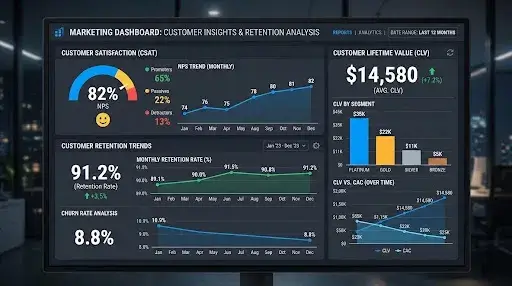
One of the clearest indicators of retention success is customer lifetime value. Rather than focusing solely on individual transactions, customer lifetime value measures the total commercial contribution a customer makes throughout their relationship with the business.
This perspective fundamentally changes how organisations approach growth.
Instead of asking how many customers were acquired this quarter, leadership begins asking how customer relationships can be strengthened over the next three, five, or even ten years. Investment decisions shift from maximising immediate sales towards creating long-term value through improved experiences, personalised communication, and ongoing engagement.
Customer lifetime value also provides important context for acquisition decisions. Businesses with strong retention can profitably invest more in acquiring high-quality customers because they know those relationships will generate value over an extended period. Organisations with poor retention rarely enjoy the same flexibility because customers leave before acquisition costs are fully recovered.
Retention therefore becomes one of the strongest drivers of marketing efficiency, profitability, and sustainable commercial growth.
How Businesses Can Build Stronger Customer Retention
Improving retention begins with understanding why customers remain loyal rather than simply analysing why they leave.
Businesses should regularly gather customer feedback throughout the relationship, not only after problems arise. Customer journeys should be reviewed to identify unnecessary friction, while onboarding experiences should ensure customers achieve meaningful value as early as possible.
Marketing, sales, and customer success teams should also work from a shared understanding of customer expectations. Consistent messaging before and after purchase helps strengthen trust while reducing the disconnects that often contribute to dissatisfaction.
Organisations should also invest in data that provides visibility across the entire customer lifecycle. Tracking engagement, purchasing behaviour, customer health indicators, and lifetime value enables leadership to make proactive decisions based on evidence rather than assumptions.
Finally, businesses should recognise that retention is not achieved through occasional campaigns or isolated initiatives. It is the cumulative result of consistently delivering value across every interaction customers have with the organisation.
Conclusion
Many businesses struggle with customer retention not because they lack capable teams or quality products, but because they approach retention too narrowly. Focusing primarily on acquisition, treating retention as a customer service function, or relying on reactive interventions creates unnecessary pressure on growth while increasing marketing costs and reducing long-term profitability.
The organisations that consistently outperform their competitors understand that customer retention begins long before the first renewal and extends across every stage of the customer journey. By aligning customer expectations with delivery, measuring relationship health beyond satisfaction, and investing in long-term customer value, they create stronger relationships that improve revenue predictability, marketing efficiency, and sustainable business growth.
At Intense Digital, we help organisations build customer retention strategies that combine customer insights, data-driven marketing, journey optimisation, and performance measurement to strengthen long-term business outcomes. By aligning acquisition, customer experience, and retention around measurable commercial objectives, we help businesses maximise the value of every customer relationship while driving profitable, sustainable growth.
If your business is investing heavily in acquiring customers but finding it increasingly difficult to retain them, it may be time to rethink your growth strategy. Book a free consultation with Intense Digital today and discover how improving customer retention can become one of your strongest competitive advantages.