

What Businesses Get Wrong About Brand Awareness as a Growth Strategy

Brand awareness has become one of the most commonly discussed objectives in marketing. Businesses invest in advertising, sponsorships, social media campaigns, content, influencer partnerships, and other visibility-driven activities with the expectation that getting more people to recognise the brand will eventually lead to stronger commercial performance. The logic appears straightforward. If more people know the business exists, more people should eventually consider it when they are ready to buy. But awareness alone does not guarantee growth.
A business can be highly visible and still struggle with customer acquisition. It can generate millions of impressions while sales remain stagnant. It can have strong social media reach, growing follower numbers, and successful campaigns without creating enough commercial demand to justify the investment.
The problem is not that brand awareness is unimportant. The problem is that many businesses treat awareness as the outcome rather than understanding the role it should play within a wider growth strategy.
People knowing that a business exists is only the beginning. Customers also need to understand what the business offers, why it is relevant to their needs, why they should choose it over competing alternatives, and what action they should take next. If awareness does not progress into consideration, preference, and eventually customer action, visibility can become an expensive marketing activity with limited commercial value.
This is particularly important in competitive markets where customers are already familiar with a large number of businesses competing for their attention. Being recognised is valuable, but recognition alone does not create differentiation.
This article explores what businesses often misunderstand about brand awareness, why visibility does not always translate into growth, and how organisations can build awareness strategies that contribute more effectively to measurable business outcomes.
Awareness Is Not the Same as Demand
One of the biggest mistakes businesses make is assuming that awareness automatically creates demand. These two concepts are connected, but they are not the same.
Brand awareness means that people recognise or remember a business. Demand means that customers have a genuine interest in solving a problem or purchasing a product or service. A business can increase awareness among thousands of people who have no immediate need for what it offers.
For example, an organisation may run a highly successful campaign that reaches a large audience and generates strong engagement. People may remember the campaign and even develop a more positive perception of the brand. However, if the campaign has not created greater relevance among the people most likely to become customers, its commercial impact may remain limited.
This does not mean the campaign has failed. Brand-building often requires time, and not every awareness activity should be expected to produce immediate conversions. However, businesses need to be clear about the role awareness is expected to play within the broader customer journey.
The important question is not simply, How many people know us? It is also, Do the right people understand why we are relevant when the need for our product or service arises?
That distinction has significant implications for growth.
Being Known Does Not Mean Being Chosen

purchasing decisions. This is because awareness does not answer the most important commercial question: Why should I choose you?
A customer may know a brand’s name and recognise its advertising but still choose a competitor because that competitor communicates its value more clearly, appears more relevant to their needs, offers a stronger customer experience, or is simply easier to buy from. This is where many awareness strategies lose momentum.
Businesses invest heavily in ensuring that people remember their name without investing enough in the message customers are expected to remember about them. The result is recognition without a strong association with a specific problem, value proposition, or reason to choose the business.
Strong awareness is therefore not simply about being familiar. It is about becoming meaningfully associated with something that matters to the customer. The brands most likely to benefit commercially from awareness are those that use repeated exposure to reinforce relevance and distinction. Customers should not only remember seeing the brand. They should have a clearer understanding of what it represents and why it deserves consideration.
Reach Can Create the Illusion of Growth
Digital marketing has made awareness easier to measure than ever before. Businesses can see exactly how many people have been reached, how many impressions an advertisement has generated, how many video views have been recorded, and how engagement has changed over time. These numbers can be useful indicators of campaign delivery, but they can also create the illusion that business growth is taking place simply because marketing activity is increasing.
A campaign reaching one million people is not automatically more valuable than a campaign reaching one hundred thousand. The quality and relevance of the audience matter. The message matters. The stage of the customer journey matters. The ability of the business to convert interest into action also matters.
If increased reach is not accompanied by stronger consideration, qualified demand, customer acquisition, or other relevant commercial indicators, the business may simply be paying to become more visible without improving its position in the market. This is why awareness metrics need context.
Rather than asking whether reach increased, businesses should ask whether awareness is increasing among strategically important audiences and whether that awareness is contributing to improvements elsewhere in the customer journey.
Awareness Without Positioning Can Strengthen Nothing
A business cannot rely on visibility to solve a positioning problem. If customers do not understand what makes an organisation different, increasing the number of people exposed to the brand may simply increase the number of people who remain uncertain about what the business actually offers.
This is particularly common when awareness campaigns rely on broad, generic messages. Statements about quality, innovation, excellent service, or customer focus may sound positive, but they rarely provide customers with a compelling reason to choose one business over another. Increasing the distribution of an unclear message does not make it clearer.
Before investing heavily in awareness, businesses need to understand what they want awareness to achieve. What should customers associate with the brand? What problem should they remember the business for solving? What makes the organisation’s approach different from competing alternatives?
Without clear answers, awareness activity can become disconnected from commercial strategy. Strong positioning gives awareness something to build. It ensures that repeated exposure reinforces a distinctive idea rather than simply increasing familiarity with a name or logo.
Brand Awareness Cannot Compensate for a Weak Customer Journey
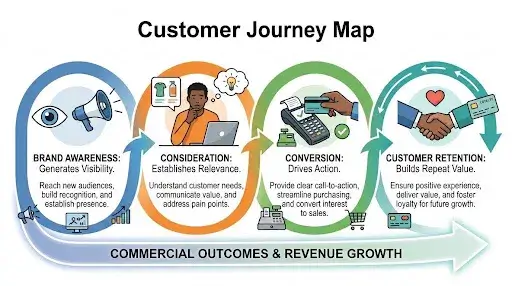
Many businesses respond to slowing growth by investing more heavily in awareness. They increase advertising budgets, expand into new channels, partner with creators, and launch campaigns designed to reach larger audiences. However, greater visibility cannot solve every growth problem.
If customers are becoming aware of the brand but struggling to understand the offer, the issue may be messaging. If prospects are visiting the website but failing to convert, the problem may be the customer journey. If customers are purchasing but failing to return, retention or product experience may require attention.
Increasing awareness in these situations can create more traffic and interest at the top of the funnel while allowing the same problems to continue further down. This can make marketing increasingly inefficient. The business spends more to attract attention but loses a significant proportion of the potential value before customers reach the point of conversion or retention.
A stronger growth strategy examines the entire system. Awareness should generate the right kind of attention. Consideration should build relevance and confidence. Conversion should make it easy for customers to take action. The product or service experience should deliver the value the brand promised, while retention activity should help the business create more value from customers it has already acquired. When these stages are disconnected, awareness alone cannot carry the weight of the entire growth strategy.
The Wrong Audience Can Make Awareness Look Successful
Large audiences can be attractive because they make campaigns appear successful. A business may be able to generate significant reach by targeting broad demographics or creating highly entertaining content, but the people seeing the campaign may have little connection to the customers the organisation actually needs to grow.
This creates another gap between marketing activity and commercial performance. The objective should not always be to reach the largest possible audience. It should be to create meaningful awareness among audiences with strategic value to the business.
This requires a stronger understanding of customer segments and buying behaviour. Which audiences are most valuable? Which customers have the greatest lifetime value? Where are future growth opportunities likely to come from? Which groups are currently unaware of the business, and which already know the brand but lack a compelling reason to choose it?
The answers can significantly change how awareness investment should be allocated. In some cases, a business does not need more people to know it exists. It needs more of the right people to understand why it matters.
Awareness Should Be Connected to Commercial Outcomes
This does not mean every awareness campaign should be judged solely by immediate sales. Some of the most important effects of brand building take time to emerge. Customers may encounter a brand months before they develop a relevant need, particularly in industries with longer buying cycles.
However, businesses should still establish a clear logic connecting awareness investment to commercial objectives. For example, an awareness strategy may be designed to increase consideration among a high-value customer segment. The business can then monitor whether consideration improves over time and whether this contributes to stronger direct traffic, higher-quality enquiries, improved conversion, or increased share of demand. The relationship will not always be immediate or perfectly linear, but measurement should move beyond asking whether people saw the campaign.
A more useful approach asks:
- Did awareness increase among the audience we are trying to grow?
- Did customers develop a clearer understanding of what makes us relevant?
- Did consideration or preference improve?
- Did demand or qualified customer activity change?
- Did the business become more efficient at acquiring customers over time?
These questions help connect brand investment to growth without reducing every marketing decision to a short-term conversion metric.
Why Awareness Strategies Often Fail to Earn Executive Confidence
One reason some executives remain sceptical about brand investment is that marketing teams often struggle to explain what awareness is expected to achieve beyond greater visibility. A report showing that reach increased by 40% may demonstrate successful media delivery, but it does not necessarily answer whether the business is becoming stronger. This creates an accountability problem.
Marketing leaders need to explain the role awareness plays within the organisation’s growth model. They need to identify the audience being targeted, the associations the business wants to build, the customer behaviour expected to change, and the indicators that will demonstrate progress. When these connections are clear, awareness becomes easier to evaluate as a strategic investment.
When they are not, the business can easily fall into a cycle of launching increasingly visible campaigns without learning whether those campaigns are improving the organisation’s commercial position. The goal is not to demand perfect attribution. Brand growth is influenced by multiple factors, and customer journeys are rarely straightforward. The goal is to establish enough evidence to understand whether awareness investment is moving the business in the right direction.
How to Build Brand Awareness Into a Real Growth Strategy
A stronger approach begins by treating awareness as one part of a connected growth system rather than an isolated marketing objective. Businesses should first define the commercial problem they are trying to solve. Are they entering a new market, reaching a previously untapped customer segment, improving consideration, supporting customer acquisition, or strengthening preference against competitors? The awareness strategy should then be designed around that objective.
A practical approach includes:
- Define the audience clearly: Focus on the customer segments most important to future growth rather than pursuing reach for its own sake.
- Strengthen positioning: Ensure customers understand what the business does, who it helps, and why its approach is relevant.
- Build distinctive associations: Use creative and messaging that help customers remember more than the brand name.
- Connect awareness to the customer journey: Ensure customers can move easily from discovery to consideration and action.
- Measure beyond reach: Track changes in consideration, demand, customer behaviour, acquisition efficiency, and other relevant commercial indicators.
- Review the entire growth system: Identify whether problems are occurring in awareness, conversion, customer experience, or retention before increasing marketing spend.
The objective is not simply to become more visible. It is to ensure that increased visibility strengthens the conditions required for sustainable growth.
Conclusion
Brand awareness remains an important part of marketing, particularly for businesses competing in crowded markets or seeking to reach new audiences. The mistake is not investing in awareness. The mistake is treating awareness as though visibility alone is a growth strategy. People can know a brand without understanding it. They can recognise its advertising without considering it when they are ready to buy. They can engage with its content without ever becoming customers.
For awareness to create greater commercial value, it needs to be connected to positioning, customer relevance, conversion, and the broader growth strategy. Businesses need to understand not only how many people are aware of them but also whether the right audiences are developing stronger associations with the brand and whether those associations are contributing to meaningful changes in customer behaviour.
At Intense Digital, we help businesses connect marketing activity to measurable commercial outcomes. By combining customer insight, brand strategy, performance marketing, and data-led decision-making, we help organisations look beyond visibility and build growth systems designed to create demand, improve conversion, and increase the value of marketing investment.
If your brand is becoming more visible but revenue is not moving at the same pace, the issue may not be that you need even more awareness. It may be that your awareness strategy is disconnected from the rest of your growth system. Book a free consultation with Intense Digital today and discover how to turn visibility into stronger customer demand, more efficient acquisition, and sustainable business growth.