

Why Marketing Activity and Business Growth Often Move in Opposite Directions

Businesses rarely struggle to generate marketing activity. Campaigns are launched, content is published, advertising budgets are increased, social media channels remain active, and marketing teams continue producing reports filled with performance metrics. From the outside, it can look like the organisation is doing everything necessary to drive growth. Yet revenue does not always reflect the level of activity.
A business can increase website traffic while generating fewer qualified opportunities. It can produce more leads while sales conversion rates decline. It can increase social media engagement while customer acquisition costs continue rising. Marketing teams may be busier than ever, but the business itself may not be growing at the same pace.
This disconnect creates what can be described as the revenue gap, the distance between everything marketing is doing and the commercial outcomes the business actually needs. The problem is not necessarily that marketing is ineffective. More often, businesses are measuring marketing through activity rather than its contribution to the wider customer journey and revenue engine. When teams are rewarded for producing more campaigns, generating more leads, or increasing engagement without understanding how those activities influence commercial performance, marketing can become increasingly busy without becoming increasingly valuable.
In competitive markets, this distinction matters. Businesses cannot afford to confuse motion with progress, particularly when marketing budgets are under greater scrutiny and leadership teams expect clearer returns from every investment.
The organisations that close the revenue gap understand that marketing does not exist to generate activity. Its purpose is to create demand, attract the right customers, influence purchasing decisions, and contribute to profitable business growth.
This article explores why marketing activity and business growth can move in opposite directions, where the disconnect usually occurs, and how businesses can build a more commercially focused marketing system that connects activity to measurable revenue outcomes.
More Marketing Activity Does Not Automatically Mean More Growth
One of the easiest assumptions to make in marketing is that more activity should produce better results. More campaigns should create more opportunities. More content should generate more traffic. More advertising should produce more leads. More channels should increase market reach. The logic sounds reasonable, but marketing does not work in a straight line.
Increasing activity without improving strategy can simply create more noise. A business may reach larger audiences without attracting the people most likely to become customers. It may generate more leads without improving lead quality. It may publish more content without addressing the questions customers actually need answered before making a purchasing decision. This is why activity must always be evaluated in context.
The important question is not how much marketing a business is producing but whether that activity is moving the right customers closer to a commercial decision. A smaller number of highly relevant interactions can create significantly more value than thousands of low-quality engagements. Marketing becomes more effective when businesses stop asking, “How much are we doing?” and start asking, “What is this activity changing?”
Vanity Metrics Can Create a False Sense of Progress
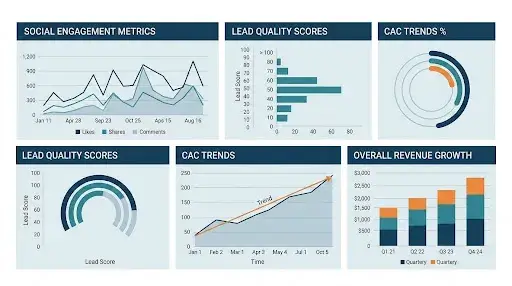
Modern marketing platforms make it easy to measure almost everything. Impressions, clicks, views, engagement, followers, downloads, website sessions, email opens, and lead volumes can all be tracked in real time. The problem is not a lack of data. It is knowing which data actually matters.
Metrics that show increased activity can create a sense of progress even when commercial performance remains unchanged. A campaign may generate thousands of clicks, but if those visitors have little purchase intent, the additional traffic contributes very little to revenue. Similarly, a significant increase in lead volume can create excitement until sales teams reveal that most of those leads are poorly qualified.
This does not make these metrics useless. They provide important information about how audiences interact with marketing. The issue arises when they become the final measure of success rather than indicators within a larger commercial picture.
Revenue-focused marketing connects activity metrics to business outcomes. It asks how campaigns influence qualified opportunities, conversion rates, customer acquisition costs, customer lifetime value, and ultimately revenue. Without this connection, businesses risk optimising metrics that look impressive while having limited impact on growth.
The Wrong Audience Can Make Successful Marketing Look Like Failure
Marketing performance can also decline when businesses focus on reaching more people rather than reaching the right people.
A campaign can achieve strong reach and engagement while attracting audiences who have little interest in purchasing the product or lack the characteristics of a profitable customer. Marketing may then appear successful because the top-level numbers look healthy, while sales teams struggle to convert the resulting opportunities. This is particularly common when campaigns are optimised around inexpensive leads or high-volume engagement. The objective of marketing should not simply be to generate demand. It should be to generate the right demand.
Understanding customer segments, buying intent, commercial value, and the problems different audiences are trying to solve allows businesses to prioritise quality over volume. This often means accepting lower headline numbers in exchange for stronger conversion and greater revenue contribution. A smaller pipeline filled with high-quality opportunities can be significantly more valuable than a large pipeline that consumes sales resources without producing meaningful results.
Messaging Can Create a Gap Between Attention and Action
A business can attract plenty of attention and still struggle to generate revenue if its messaging does not make the value of the offer clear. Customers may notice an advertisement, visit a website, or engage with content without understanding why the business is relevant to their specific needs. When that happens, marketing succeeds at generating awareness but fails to create sufficient confidence to move customers forward.
This is where the difference between attention and action becomes important. Effective marketing does not simply capture attention. It gives customers a reason to continue the journey. It explains the problem being solved, communicates the value of the solution, differentiates the business from alternatives, and makes the next step clear.
When messaging is generic, inconsistent, or overly focused on the business itself, prospects may remain interested without becoming customers. The result is another form of revenue gap: marketing generates attention that never becomes commercial intent.
Marketing and Sales Can Be Measuring Different Versions of Success