

Before Cutting Your Marketing Budget, Ask These 5 Questions

When business performance comes under pressure, marketing is often one of the first areas leadership teams consider cutting. The reasoning can appear straightforward. If revenue is slowing, costs need to come down, and reducing marketing spend seems like an obvious way to protect the bottom line.
The problem is that marketing is not simply another operating expense. Marketing investment influences demand generation, customer acquisition, brand visibility, sales pipeline, customer retention, and future revenue. Cutting it without understanding what is actually driving performance can reduce costs in the short term while creating a much larger commercial problem later.
This does not mean every marketing budget should be protected indefinitely. There are situations where spending needs to be reduced, campaigns need to be stopped, or investment needs to be redirected. Inefficient marketing should not receive more funding simply because it has always been funded.
The real question is whether the business is cutting waste or cutting growth capacity. That distinction requires a more thoughtful approach to budget decisions. Rather than asking how much marketing spend can be removed, leadership should first understand which investments are generating value, which are underperforming, and what consequences a reduction could have on customer acquisition and future revenue.
In competitive markets, this matters even more. Competitors do not stop investing simply because one business decides to reduce its visibility. Customers continue making purchasing decisions, new alternatives continue entering the market, and brands that disappear from consideration can find it difficult and expensive to regain attention later.
Before reducing your marketing budget, there are five questions worth answering.
1. Are We Cutting Inefficiency or Cutting Growth?
The first question is the most important because not every marketing expense contributes equally to business growth. A budget review should identify where marketing investment is creating measurable value and where it is producing limited returns. Some campaigns may be generating qualified opportunities at an attractive cost, while others consume significant resources without contributing meaningfully to pipeline or revenue.
Treating these investments as if they are equally valuable can lead to poor decisions. The objective should be to identify the activities that are inefficient and reduce or eliminate them while protecting the activities that create sustainable commercial value. This could mean reducing spend on poorly performing channels while maintaining investment in campaigns that consistently generate high-quality customers.
A smaller, more efficient marketing budget can outperform a larger one if resources are allocated towards the right opportunities. Before cutting the overall budget, businesses should therefore ask where the inefficiency actually exists. If the problem is poor allocation rather than insufficient demand, reducing total investment may solve the wrong problem.
2. What Happens to Customer Acquisition If We Spend Less?
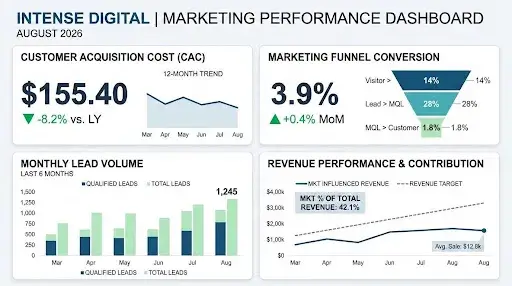
Reducing marketing spend often produces an immediate financial benefit because the business sees lower expenditure. What is less immediately visible is what happens to customer acquisition afterwards.
If fewer prospects enter the marketing funnel, sales teams may have fewer opportunities to pursue. If campaigns are paused, brand visibility may decline. If acquisition channels are reduced too aggressively, the organisation may become increasingly dependent on a smaller pool of existing customers.
This is particularly important when customer acquisition costs are already increasing. A reduction in spend does not necessarily reduce acquisition costs proportionally. In some cases, it can make acquisition less efficient because businesses lose the scale, audience data, or campaign momentum that previously supported performance.
Leadership should therefore model what a budget reduction is expected to do to customer acquisition. How many fewer prospects are likely to enter the funnel? What happens to qualified leads? How could sales pipeline change? How might the reduction affect revenue several months from now? Marketing decisions should account for these downstream effects rather than focusing only on immediate cost savings.
3. Which Marketing Activities Are Building Future Demand?
One of the biggest challenges in evaluating marketing is that not every activity produces an immediate commercial result. Performance campaigns can often be connected relatively quickly to leads or conversions. Other activities, such as brand building, content, thought leadership, audience development, and customer education, may influence purchasing decisions over a longer period.
During difficult financial periods, these activities are often the first to be reduced because their immediate contribution is harder to demonstrate. That can be a mistake. Customers rarely move from first exposure to purchase instantly. They may encounter a brand multiple times, consume educational content, compare alternatives, speak to sales teams, and return to the business weeks or months later before making a decision.
Marketing that builds familiarity and trust contributes to this process even when the final conversion occurs elsewhere. This does not mean businesses should continue funding every long-term marketing initiative regardless of performance. It means leadership should understand the role each activity plays before deciding whether to cut it. A business that eliminates all future-demand activity to protect short-term numbers can eventually create a pipeline problem that only becomes visible after the budget has already been reduced.
4. Are We Measuring Marketing Against the Right Outcomes?

Sometimes the desire to cut marketing comes from poor performance reporting rather than poor marketing performance.
If leadership sees declining impressions, engagement, or lead volumes, it may conclude that marketing is becoming less effective. But these metrics do not necessarily tell the full commercial story.
A campaign generating fewer leads can still create greater value if those leads are better qualified and more likely to convert. A channel with a higher acquisition cost may still be more profitable if it attracts customers with greater lifetime value. Similarly, a campaign may influence revenue without receiving direct attribution for the final conversion.
This is why marketing budgets should be evaluated using metrics that reflect the economics of the business.
Important measures can include:
- Customer acquisition cost
- Qualified lead volume
- Lead-to-customer conversion rate
- Customer lifetime value
- Pipeline contribution
- Revenue generated or influenced
- Return on marketing investment
- Retention and repeat purchase rates
The right combination will depend on the business model, sales cycle, and customer journey, but the principle remains the same: marketing should be evaluated based on the value it creates, not simply the activity it generates.
Before cutting the budget, businesses should make sure they actually understand what their current investment is producing.
5. What Will Competitors Do If We Pull Back?
Marketing budgets do not exist in isolation. Every market contains competitors competing for the same customers, attention, search visibility, and share of voice. When one business reduces its presence, competitors have an opportunity to become more visible and strengthen their position. This does not mean businesses should continue spending simply because competitors are spending. Strategic decisions should always be based on commercial opportunity rather than fear of being left behind.
However, leadership should understand the competitive implications of reducing marketing activity. If competitors continue investing in customer acquisition while your business becomes less visible, they may capture demand that would previously have considered your brand. They may strengthen relationships with customers, build greater familiarity, and establish stronger market positioning.
Recovering that lost ground later may require significantly more investment than maintaining a measured presence throughout the downturn. The question is therefore not simply, “Can we afford to spend less?” It is also, “What position will this decision leave us in when the market improves?”
Cutting the Budget Is Not the Only Way to Improve Efficiency
When marketing budgets come under scrutiny, businesses often jump directly to reduction. A more effective approach may be to improve how the existing budget is being used. This could involve consolidating underperforming channels, improving targeting, refining messaging, reducing inefficient creative production, renegotiating media costs, improving conversion rates, or reallocating investment towards higher-value customer segments.
In other words, the answer may not be less marketing. It may be better marketing. Improving conversion rates can increase the value generated from existing traffic without increasing media spend. Better customer segmentation can reduce wasted impressions. Stronger messaging can improve campaign efficiency. More effective landing pages can turn existing demand into more customers. These improvements can sometimes create greater financial impact than simply reducing the total marketing budget. The strongest organisations therefore treat budget reviews as opportunities to improve efficiency rather than automatic exercises in cost reduction.
What to Do If the Budget Really Does Need to Come Down
There will be circumstances where reducing marketing investment is necessary. When that happens, businesses should make the cuts strategically rather than evenly distributing reductions across every activity.
Start by identifying the channels and campaigns with the weakest relationship between investment and commercial outcomes. Then evaluate what role each activity plays in the customer journey before removing it completely.
Protect high-performing acquisition channels where possible, maintain critical customer communication, and preserve activities that support future demand and brand consideration. At the same time, eliminate unnecessary duplication, low-value activity, and spending that cannot be connected to a meaningful objective.
Most importantly, establish clear conditions for restoring investment. If the business is temporarily reducing spend because of market conditions, leadership should know what signals would justify increasing it again. This turns a budget cut from a reactive decision into a controlled strategic response.
Conclusion
Cutting marketing spend can provide immediate cost relief, but it can also create longer-term consequences that are not visible on the balance sheet straight away. Reduced demand generation, weaker customer acquisition, declining brand consideration, and smaller sales pipelines can all emerge later, making an apparently sensible short-term decision considerably more expensive over time.
The right approach is not to protect every marketing expense regardless of performance. It is to understand what each investment contributes, identify where inefficiencies exist, and ensure that any reduction protects the organisation’s ability to generate profitable growth.
Before cutting your marketing budget, ask five questions: Are we cutting inefficiency or growth? What happens to customer acquisition if we spend less? Which activities are building future demand? Are we measuring marketing against the right outcomes? And what will competitors do if we pull back?
The answers provide a much stronger basis for deciding where to reduce, where to reallocate, and where continued investment is essential.
At Intense Digital, we help organisations evaluate marketing investment through a commercial lens, connecting strategy, performance data, customer acquisition, and revenue outcomes. Our approach is designed to help businesses identify where marketing spend is creating value, where efficiency can be improved, and how budgets can be allocated to support profitable, sustainable growth.
If you’re considering cutting your marketing budget, the most important question may not be “How much can we save?” but “What growth are we putting at risk?” Book a free consultation with Intense Digital today and discover how to make smarter marketing investment decisions based on performance, efficiency, and measurable business outcomes.