

The Hidden Cost of Reactive Marketing Decisions

Marketing leaders today operate under constant pressure. Campaigns must deliver results quickly, competitors are moving aggressively, customer behaviour changes rapidly, and executive teams expect clear evidence that marketing investment is translating into business growth. In this environment, it is easy for decision-making to become reactive.
A campaign underperforms, and budget is shifted immediately. A competitor launches a new initiative, and the team rushes to respond. A sudden drop in engagement triggers an urgent change in strategy. Leadership requests quick wins, and long-term priorities are temporarily abandoned in favour of short-term activity.
These reactions often appear sensible in the moment. They create the impression of responsiveness and urgency. However, when reactive decision-making becomes the dominant operating pattern, marketing loses strategic coherence. Teams spend more time responding to immediate signals than building systems that drive sustainable growth.
The hidden cost of reactive marketing decisions is rarely visible in a single campaign. It accumulates gradually through wasted budget, inconsistent messaging, fragmented execution, and declining organisational confidence. Over time, marketing becomes busy but unpredictable, active but inefficient.
This article explores why reactive decision-making is so common, the often-overlooked costs it creates, and how organisations can adopt a more disciplined and strategic approach to marketing leadership.
What Reactive Marketing Decisions Actually Look Like
Reactive marketing occurs when decisions are driven primarily by short-term events rather than by a clear strategic framework.
Examples include:
- Changing campaign direction after only a few days of data
- Reallocating budget based on isolated metrics rather than full-funnel performance
- Chasing competitors’ tactics without assessing strategic fit
- Producing content solely in response to trends
- Abandoning long-term initiatives to satisfy immediate executive concerns
- Launching new channels without a defined role in the customer journey
These actions are not inherently wrong. In some situations, rapid adaptation is necessary. The problem arises when the organisation lacks a structured process for distinguishing meaningful signals from temporary noise. Without this discipline, marketing becomes governed by urgency rather than insight.
Why Organisations Fall Into Reactive Marketing
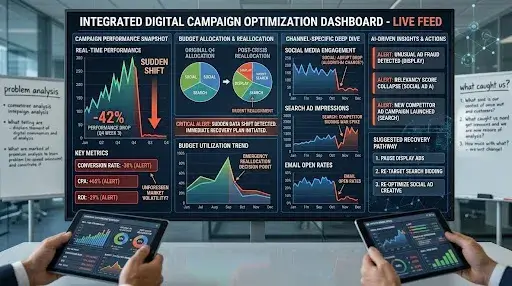
Reactive decision-making is usually the result of systemic pressures rather than poor judgment.
Executive Pressure for Immediate Results: Boards, CEOs, and CFOs often require rapid evidence of marketing impact. This pressure can lead teams to prioritise visible activity over strategic consistency.
Fragmented Data: When reporting systems provide conflicting or incomplete information, leaders may respond to whichever metric appears most concerning at the moment.
Lack of Strategic Clarity: If objectives and priorities are not clearly defined, teams have no stable framework for evaluating unexpected developments.
Competitive Anxiety: Visible competitor activity can create a fear of falling behind, prompting rushed decisions that may not suit the organisation’s own strategy.
Short-Term Incentives: When performance is measured primarily through monthly metrics, teams naturally optimise for immediate outcomes rather than long-term value.
The Hidden Costs of Reactive Marketing Decisions
The impact of reactive marketing is often substantial, even when it is not immediately obvious.
Budget Inefficiency: Frequent tactical changes disrupt optimisation and prevent campaigns from generating reliable learning. Spend increases while performance remains inconsistent.
Strategic Drift: As priorities shift repeatedly, marketing loses focus and coherence. Campaigns become disconnected rather than reinforcing a unified growth strategy.
Inconsistent Messaging: Constant changes in direction weaken positioning and create a fragmented customer experience.
Reduced Team Productivity: Teams spend significant time responding to urgent requests rather than executing thoughtfully planned initiatives.
Poor Data Interpretation: When decisions are made too quickly, normal fluctuations are mistaken for meaningful trends, leading to unnecessary changes.
Erosion of Organisational Confidence: When performance becomes unpredictable, leadership begins to question marketing’s effectiveness and strategic value.
How Reactive Decisions Affect the Customer Journey
Customers experience marketing as a sequence of connected interactions. Reactive decision-making disrupts this continuity. At the acquisition stage, targeting may shift before enough data is available. During activation, messaging may change before trust is established. In retention, attention may move away from existing customers in pursuit of new opportunities. These disruptions reduce conversion efficiency and increase customer acquisition costs. Growth becomes more volatile because the system is constantly being altered before improvements have time to compound.
The Difference Between Agility and Reactivity
It is important to distinguish between strategic agility and reactive behaviour. Strategic agility involves adapting based on structured analysis, clear objectives, and reliable data. It is deliberate and evidence-based. Reactivity, by contrast, is driven by immediate pressure and incomplete interpretation. It prioritises speed over understanding. Strong marketing leaders are agile, not reactive. They adapt thoughtfully while maintaining strategic consistency.
Building a More Disciplined Decision-Making System

Establish Clear Strategic Priorities: Define the business outcomes marketing is expected to achieve and use these objectives as the basis for all decisions.
Create Reliable Sources of Truth: Ensure that teams and leadership work from consistent data definitions and shared performance metrics.
Set Decision Thresholds: Determine in advance how much data is required before significant changes are made.
Measure Full-Funnel Performance: Evaluate acquisition, activation, retention, and revenue rather than isolated channel metrics.
Conduct Structured Performance Reviews: Use regular reviews to interpret trends, test assumptions, and agree on strategic actions.
Educate Leadership on Marketing Dynamics: Help executives understand the difference between short-term fluctuations and meaningful performance changes.
What Strong Marketing Leadership Does Differently
High-performing marketing leaders do not eliminate uncertainty, but they create systems that reduce unnecessary volatility.
They:
- Make decisions within a clear strategic framework
- Balance short-term responsiveness with long-term consistency
- Use data to inform judgment rather than replace it
- Protect teams from unnecessary tactical disruptions
- Focus on learning that compounds over time
This leadership approach transforms marketing from a reactive function into a stable engine for growth.
What CEOs and Boards Should Expect
Executive teams should expect marketing leaders to provide:
- Clear strategic rationale for major decisions
- Reliable reporting tied to business outcomes
- Disciplined experimentation
- Transparent explanations of what is changing and why
- Consistent alignment between short-term actions and long-term goals
When these expectations are met, leadership gains greater confidence in both marketing investment and performance forecasts.
Turning Marketing Into a Predictable Growth System
The most successful organisations understand that sustainable growth is built through disciplined decision-making rather than constant reaction. By replacing urgency-driven responses with structured analysis and strategic clarity, marketing becomes more efficient, more predictable, and more commercially effective. Teams work with greater focus, budgets are allocated more intelligently, and customer journeys become more coherent. The result is not slower marketing. It is smarter marketing.
Conclusion
Reactive marketing decisions often feel productive, but their hidden cost can be substantial. They lead to wasted budget, fragmented strategies, inconsistent customer experiences, and declining confidence in marketing’s contribution to growth.
The solution is to build systems that support disciplined, data-informed decisions grounded in clear strategic objectives. When organisations adopt this approach, marketing becomes less volatile and far more effective.
At Intense Digital, we help organisations design ROI-focused marketing systems that replace reactive decision-making with strategic clarity and measurable performance. Our approach integrates growth strategy, analytics, full-funnel optimisation, and performance marketing to ensure every decision contributes to long-term business value.
If your marketing decisions are increasingly driven by urgency rather than insight, reach out to Intense Digital for a free consultation and let us help you build a more disciplined and predictable path to growth.