
The Customer Experience Gaps That Quietly Reduce Revenue

Many organisations assume that declining revenue is primarily the result of weak marketing, aggressive competition, or changing market conditions. While these factors undoubtedly influence business performance, they are rarely the only explanation. In many cases, the real problem lies much closer to home, hidden within the everyday interactions customers have with the business.
These interactions often appear too small to attract immediate attention. A delayed response to an enquiry, inconsistent messaging across communication channels, a complicated checkout process, or a confusing onboarding experience may seem like isolated operational issues rather than strategic business concerns. Yet when these moments occur repeatedly across hundreds or even thousands of customer interactions, they quietly erode trust, reduce conversion rates, and weaken long-term customer relationships. The financial impact is rarely dramatic enough to trigger alarm overnight, but over time these seemingly minor breakdowns create substantial revenue leakage that becomes increasingly difficult to recover.
This is why customer experience has evolved beyond being a customer service responsibility. It has become a commercial growth strategy. Every interaction between a customer and a business either strengthens confidence or introduces uncertainty. Every touchpoint either moves a prospect closer to making a purchase or creates enough friction to encourage them to look elsewhere. Organisations that consistently outperform their competitors understand this reality and invest as much effort in removing obstacles from the customer journey as they do in attracting new customers.
Unfortunately, many businesses continue to focus almost exclusively on acquisition while overlooking the quality of the journey that follows. Marketing campaigns become more sophisticated, advertising budgets continue to increase, and customer acquisition efforts expand across multiple channels. Yet if the experience customers encounter after engaging with the brand feels inconsistent, confusing, or unnecessarily difficult, the additional investment simply amplifies an inefficient system. More people enter the journey, but too few complete it.
This article explores where customer experience gaps typically occur, why they have such a profound impact on commercial performance, and how organisations can redesign the customer journey to reduce friction, improve customer confidence, and unlock sustainable revenue growth.
Customer Experience Has Become One of the Most Powerful Drivers of Business Growth
The modern customer evaluates businesses very differently from how they did only a few years ago. Instead of comparing one organisation solely against its direct competitors, customers compare every interaction against the best experience they have received from any company, regardless of industry. A seamless online purchase from a retailer, an intuitive banking application, or an exceptionally responsive technology provider all shape expectations that customers carry into future buying decisions.
As a result, businesses are no longer judged only by the quality of their products or services. Increasingly, they are judged by how easy they are to do business with. Customers expect websites to be intuitive, communication to be timely, purchasing processes to be straightforward, and support to be accessible whenever assistance is needed. Organisations that consistently meet these expectations build trust more quickly, while those that introduce unnecessary complexity often lose customers before they fully appreciate the value being offered.
This shift has significant commercial implications. Product quality remains essential, but it is no longer sufficient on its own. Even organisations with outstanding products can struggle to achieve sustainable growth if customers encounter repeated friction throughout the buying journey. Conversely, businesses with comparable offerings frequently outperform their competitors simply because they make every interaction easier, faster, and more reassuring.
Customer experience therefore represents far more than operational excellence. It has become one of the strongest competitive advantages available to modern organisations because it directly influences acquisition, conversion, retention, and customer advocacy.
Revenue Rarely Declines Because of One Major Failure
One of the greatest challenges facing leadership teams is that customer experience problems rarely announce themselves through dramatic failures. Revenue seldom falls because of one catastrophic mistake. Instead, growth slows gradually as small moments of friction accumulate throughout the customer journey.
A prospective customer may leave a website because pricing information is difficult to find. Another may submit an enquiry but lose interest after waiting several days for a response. A qualified lead may abandon the buying process because they receive conflicting information from different departments. Existing customers may quietly decide not to renew because onboarding failed to demonstrate value quickly enough or because ongoing communication gradually became inconsistent.
Each of these situations appears relatively insignificant when viewed in isolation. Individually, they may affect only a handful of customers and generate little immediate concern. Collectively, however, they create a pattern of declining customer confidence that becomes increasingly expensive to overcome. Marketing teams respond by generating more leads, sales teams work harder to close opportunities, and leadership authorises larger budgets to stimulate growth. Yet the underlying issue remains unresolved because the business continues losing value at multiple stages of the customer journey.
Understanding this gradual nature of revenue leakage is essential because it changes how organisations approach growth. Rather than assuming that stronger campaigns or higher marketing investment will solve performance challenges, leaders begin examining how effectively customers move through every stage of their relationship with the business.
The Most Common Customer Experience Gaps That Reduce Revenue
Although every organisation has unique challenges, customer experience breakdowns generally occur in several predictable areas. Identifying these points of friction is often the first step towards improving commercial performance because they reveal where momentum is being lost long before revenue appears on financial reports.
Unclear First Impressions
The customer journey begins long before a prospect speaks with a sales representative or completes a purchase. It starts with the very first interaction someone has with the organisation, whether that occurs through a search engine, social media platform, advertisement, referral, website, or piece of thought leadership content.
At this stage, prospective customers are attempting to answer several important questions. Does this organisation understand the problem I am trying to solve? Can I trust their expertise? Is their solution relevant to my needs? What should I do next if I want to learn more?
Many businesses unintentionally make these questions difficult to answer. Their messaging focuses heavily on products and services rather than customer challenges. Different marketing channels communicate slightly different value propositions. Websites prioritise company information instead of guiding visitors towards meaningful action. Navigation becomes unnecessarily complex, requiring users to search extensively before finding the information they need.
These issues may appear minor from an internal perspective because employees already understand the business. Customers, however, experience something entirely different. Every moment spent searching for information introduces uncertainty, and uncertainty almost always reduces the likelihood of conversion.
Strong customer experiences begin with clarity. Prospective customers should immediately understand who the organisation serves, what problems it solves, why it is different, and what action they should take next. When this foundation is established effectively, every subsequent interaction becomes significantly more productive.
Communication That Weakens Rather Than Builds Confidence
Communication plays a central role throughout the customer journey because it shapes how customers interpret every interaction with the business. While organisations often focus on communicating frequently, the real objective should be communicating consistently, clearly, and in a way that steadily builds confidence.
Unfortunately, this is where many businesses begin losing momentum. Enquiries receive delayed responses despite significant investment in lead generation. Prospective customers receive generic follow-up emails that fail to acknowledge their specific interests or previous conversations. Marketing promises one experience while sales representatives communicate something slightly different, creating uncertainty about what customers should actually expect.
These inconsistencies rarely generate immediate complaints. Instead, they slowly reduce confidence by making customers question whether the organisation truly understands their needs or has the internal coordination required to deliver on its promises.
Every communication should reinforce the value proposition established during earlier interactions. Rather than forcing customers to reconnect the dots themselves, organisations should create a continuous narrative that steadily moves prospects from curiosity towards confidence. Businesses that achieve this consistency often improve conversion rates without increasing marketing expenditure because customers feel reassured throughout the decision-making process.
Communication Breakdowns Often Reflect Organisational Misalignment

Many customer experience challenges are mistakenly viewed as isolated operational problems when, in reality, they are symptoms of a much deeper issue: internal misalignment. Customers experience the organisation as one brand, yet internally, different departments often operate with different priorities, systems, and definitions of success.
Marketing may focus on generating leads, sales may prioritise closing opportunities, customer success may concentrate on retention, and finance may focus on cost control. While each objective is legitimate, problems emerge when these teams operate independently rather than as parts of one connected customer journey. Information is lost during handovers, messaging becomes inconsistent, and customers are forced to repeat conversations or clarify details that should already be known.
This fragmentation creates unnecessary friction that customers immediately notice, even if individual departments believe they are performing well. A prospect who receives conflicting information from marketing and sales begins to question the organisation’s credibility. A new customer who must repeatedly explain their requirements to different teams starts to lose confidence in the company’s ability to deliver. Over time, these seemingly minor frustrations influence purchasing decisions far more than many organisations realise.
Businesses that consistently deliver exceptional customer experiences rarely achieve this because one department performs exceptionally well. Instead, they succeed because every team understands its role within the broader customer journey and works towards shared commercial outcomes rather than isolated departmental targets.
Why Investing More in Marketing Cannot Solve Customer Experience Problems
When growth begins to slow, many organisations instinctively increase marketing activity. Additional advertising campaigns are launched, more content is created, budgets are expanded, and new channels are explored in the hope of attracting more customers.
While these initiatives can increase visibility, they rarely address the root cause of declining commercial performance if customer experience remains fragmented. Increasing acquisition without improving the customer journey is similar to pouring more water into a leaking bucket. More prospects enter the system, but too many leave before becoming profitable customers.
This explains why some organisations continue increasing marketing budgets while experiencing only modest improvements in revenue. The challenge is not attracting attention. It is converting that attention into meaningful business outcomes. Unless the customer journey has been carefully designed to guide prospects smoothly from awareness to purchase and beyond, additional marketing investment simply amplifies existing inefficiencies.
Sustainable growth requires organisations to optimise both ends of the equation. Customer acquisition remains essential, but equal attention must be given to activation, conversion, onboarding, retention, and customer advocacy. When every stage of the journey works together, marketing investment becomes significantly more effective because fewer opportunities are lost through avoidable friction.
How to Identify Customer Experience Gaps Before They Affect Revenue
Many organisations only begin investigating customer experience after commercial performance has already declined. By that stage, revenue leakage has often been occurring for months, making recovery slower and more expensive. A more effective approach is to identify friction proactively before it begins influencing financial performance.
One of the most valuable exercises leadership teams can undertake is mapping the complete customer journey from the customer’s perspective rather than the organisation’s internal structure. This involves examining every interaction a customer experiences, from the first advertisement they encounter to becoming a loyal advocate for the business.
During this process, organisations should ask several important questions:
- Is our value proposition communicated consistently across every touchpoint?
- Where do customers typically hesitate, abandon the process, or request additional clarification?
- Are handovers between marketing, sales, customer success, and support seamless or fragmented?
- Does every communication reinforce confidence, or does it introduce unnecessary uncertainty?
- Are we measuring customer experience throughout the journey or only after the sale has been completed?
These questions often reveal opportunities that traditional performance reports fail to identify. Instead of focusing solely on marketing metrics or sales performance, organisations begin evaluating the complete system that influences customer behaviour.
Building a Customer Journey That Supports Sustainable Revenue Growth
.
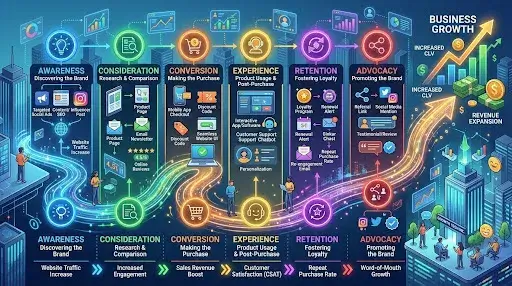
Removing customer experience friction is not about creating perfection. Rather, it is about making progress intentional by ensuring that every stage of the customer journey supports the next. Organisations that consistently improve customer experience tend to follow several common principles that strengthen both customer relationships and commercial performance.
The first is establishing complete clarity throughout the buying journey. Customers should always understand what the organisation offers, why it matters, and what action they should take next. Uncertainty delays decisions, while clarity creates confidence.
The second is maintaining consistency across every customer interaction. Whether a prospect engages with a social media campaign, downloads a resource, visits the website, speaks with a salesperson, or contacts customer support, the underlying message should remain coherent. Every interaction should reinforce the promises made earlier rather than introducing conflicting information.
The third is reducing unnecessary complexity wherever possible. Customers appreciate businesses that make decisions easier rather than more complicated. Simplified forms, intuitive navigation, faster response times, transparent pricing, and straightforward purchasing processes all contribute to stronger commercial outcomes because they reduce the effort required to become a customer.
Another essential principle is aligning internal teams around shared business objectives. Marketing, sales, customer success, and leadership should evaluate performance using metrics that reflect customer progress rather than isolated departmental activity. When every function understands how its work contributes to revenue, collaboration improves naturally and customer experience becomes more consistent.
Finally, organisations should treat customer feedback as a strategic growth asset rather than a customer service metric. Complaints, objections, abandoned purchases, and support enquiries often reveal where friction exists long before financial reports expose declining revenue. Businesses that continuously learn from these signals are able to improve the customer journey before competitors recognise similar opportunities.
What Leadership Should Expect from Customer Experience Strategy
Executive teams should expect customer experience to deliver measurable commercial value rather than simply improving customer satisfaction scores. A well-designed customer experience strategy should provide greater visibility into where customers are progressing, where they are disengaging, and what operational changes will have the greatest impact on revenue.
Leaders should also expect clear accountability across the organisation. Customer experience is not owned exclusively by customer service or marketing. It is influenced by every department that shapes the customer journey, making cross-functional collaboration essential for long-term success.
Most importantly, leadership should expect customer experience initiatives to be measured using business outcomes rather than operational activity alone. Improvements should translate into stronger conversion rates, lower customer acquisition costs, higher retention, increased customer lifetime value, and more predictable revenue growth. When customer experience is connected directly to these commercial metrics, it becomes far easier to justify investment and prioritise continuous improvement.
Conclusion
Many organisations lose revenue without immediately recognising why. Products remain competitive, marketing activity continues, and sales teams work hard, yet commercial performance fails to reach its full potential because customers encounter unnecessary friction throughout their journey. These experience gaps rarely appear dramatic in isolation, but together they create a steady loss of trust, momentum, and ultimately, revenue.
The businesses that achieve sustainable growth understand that customer experience is not simply about delivering good service. It is about designing an end-to-end journey that makes it easy for customers to discover the brand, understand its value, make confident purchasing decisions, and continue building long-term relationships. Every improvement in clarity, consistency, communication, and collaboration strengthens this journey and creates measurable commercial advantage.
At Intense Digital, we help organisations identify the customer experience gaps that quietly reduce revenue and transform fragmented customer journeys into integrated growth systems. By combining strategy, data, customer journey mapping, and performance marketing, we enable businesses to remove friction, improve conversions, strengthen retention, and maximise the return on every marketing investment.
If your organisation is attracting attention but not seeing proportional business growth, the problem may not be your marketing. It may be the experience customers have after they engage with your brand. Book a free consultation with Intense Digital and discover how a customer journey built around clarity, consistency, and measurable outcomes can unlock sustainable revenue growth.