

Why Marketing Budgets Keep Rising But Business Results Stay Flat

Across many organisations, marketing budgets have steadily increased over the past few years. More is being spent on paid media, content production, tools, platforms, and agency partnerships than ever before. On paper, this should translate into stronger visibility, better customer acquisition, and ultimately, higher revenue.
Yet for many brands, the expected results do not materialise. Spend increases, activity expands, dashboards become more detailed, but business performance does not improve at the same pace. This disconnect creates a difficult question for leadership: if more money is going into marketing, why is growth not following?
The answer is rarely about effort or intent. In most cases, the issue lies in how marketing investment is structured, measured, and connected to business outcomes. Without the right systems in place, increased budget often amplifies inefficiencies rather than driving meaningful results.
This article explores why marketing budgets continue to grow without delivering proportional business impact, where the breakdown typically occurs, and how organisations can restructure their approach to ensure that every pound or naira spent contributes to measurable growth.
The Illusion That More Spend Equals More Growth
One of the most common assumptions in modern marketing is that increasing budget will automatically improve results. While additional investment can expand reach and create more opportunities for engagement, it does not guarantee that those interactions will convert into customers or revenue.
In many cases, increased spend simply leads to more of the same activity. More impressions are generated, more clicks are recorded, and more campaigns are launched, but the underlying system remains unchanged. If the existing marketing engine is not effectively converting attention into value, scaling it will only produce larger volumes of inefficient outcomes.
This is why organisations often experience diminishing returns as budgets grow. Early gains may be visible when spend is increased, but over time, the cost of acquiring each additional customer rises while the overall impact on revenue becomes less significant.
Where Marketing Investment Breaks Down
The gap between budget and results usually appears when marketing investment is not aligned with the full customer journey. Many organisations allocate significant resources to top-of-funnel activity, focusing on awareness and traffic generation, while underinvesting in the stages that convert interest into revenue.
Paid campaigns may drive large volumes of visitors to a website, but if the user experience is weak, conversion rates remain low. Content may attract attention, but if it does not guide prospects toward action, engagement does not translate into sales. Leads may be generated, but if follow-up processes are inconsistent, opportunities are lost before they become revenue.
Each of these breakdowns reduces the effectiveness of marketing spend. The organisation is investing in visibility without ensuring that visibility leads to meaningful outcomes.
The Hidden Cost of Fragmented Marketing Systems

Another major factor is fragmentation. As marketing has become more complex, many organisations have adopted multiple tools, platforms, and channels without fully integrating them into a cohesive system. Paid media, social content, email marketing, analytics, and sales processes often operate in isolation.
This fragmentation makes it difficult to track how marketing activity contributes to business results. Different teams may rely on different data sources, leading to conflicting interpretations of performance. Decisions are made based on partial information, and opportunities for optimisation are missed.
When systems are not connected, budget allocation becomes less effective. Resources may be directed toward channels that appear to perform well in isolation but do not contribute meaningfully to overall growth. At the same time, high-impact areas may be underfunded because their value is not fully understood.
Why Activity Metrics Mislead Budget Decisions
Many organisations still rely heavily on activity-based metrics when evaluating marketing performance. Impressions, clicks, reach, and engagement are useful indicators of visibility, but they do not provide a complete picture of how marketing contributes to revenue.
When budget decisions are based on these metrics, investment tends to flow toward activities that generate the most visible output rather than the most meaningful outcomes. Campaigns that drive large volumes of traffic may receive increased funding, even if conversion rates remain low. Meanwhile, initiatives that improve customer retention or increase lifetime value may be overlooked because their impact is less immediately visible.
This creates a cycle where budget is continuously directed toward activity rather than effectiveness. Over time, the gap between spend and results becomes more pronounced.
The Misalignment Between Marketing, Sales, and Leadership
In many organisations, the challenge is not only external but also internal. Marketing, sales, and leadership teams often operate with different definitions of success. Marketing may focus on generating leads or increasing engagement. Sales may focus on closing deals. Leadership may focus on revenue and profitability.
When these perspectives are not aligned, it becomes difficult to connect marketing spend to business outcomes. Marketing reports may show strong performance, while sales teams struggle to convert leads into customers. Leadership sees increasing investment without a clear explanation of its impact on revenue. This misalignment leads to frustration and uncertainty. Budget discussions become more complex, and confidence in marketing as a driver of growth begins to decline.
Why Increasing Budget Alone Cannot Solve the Problem
When results do not match expectations, the instinct is often to increase investment further in the hope of improving performance. While this approach may create short-term gains, it does not address the underlying issues.
If the marketing system is not designed to convert attention into value, additional budget will simply increase the scale of inefficiency. Costs rise, but outcomes remain inconsistent. Over time, this can lead to significant waste and reduced confidence in marketing as a strategic function. The solution is not to spend more, but to spend better. This requires a shift from activity-driven investment to outcome-driven strategy.
How to Align Marketing Budgets with Business Results
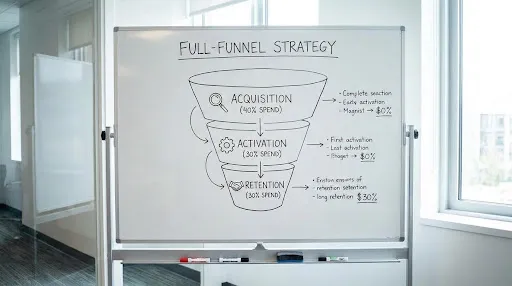
To ensure that marketing budgets deliver meaningful impact, organisations need to rethink how investment decisions are made.
The first step is to define clear business objectives and ensure that every area of marketing supports those goals. Budget allocation should be guided by the role each activity plays in driving revenue, not just by its visibility or popularity.
The second step is to adopt a full-funnel perspective. Investment should be balanced across acquisition, activation, and retention to ensure that attention is converted into long-term value. This may involve reallocating resources from top-of-funnel campaigns to areas such as conversion optimisation, customer experience, and retention strategies.
The third step is to improve measurement. Organisations need to track metrics that reflect real business progress, such as conversion rates, customer acquisition cost, lifetime value, and revenue contribution. This allows for more informed budget decisions and more effective optimisation.
The fourth step is to integrate systems and data sources. A connected marketing and sales ecosystem provides a clearer view of performance and makes it easier to identify which activities are driving results.
Finally, alignment across teams is essential. Marketing, sales, and leadership must operate with a shared understanding of success and a common framework for evaluating performance.
What Leaders Should Expect from Marketing Investment
Leadership teams should expect marketing budgets to be tied directly to business outcomes. This means having clear visibility into how spend translates into customer acquisition, revenue growth, and long-term value.
They should also expect transparency and accountability. Marketing teams should be able to explain not only what is happening, but why it is happening and what actions will be taken to improve performance.
In addition, leaders should expect continuous optimisation. Marketing is not static, and budget allocation should evolve based on data and insights. The goal is not to maintain activity but to improve effectiveness over time.
Turning Budget into a Growth Lever
When marketing budgets are aligned with strategy, measurement, and execution, they become a powerful lever for growth rather than a source of uncertainty. Investment is directed toward activities that deliver value, inefficiencies are identified and addressed, and the organisation gains confidence in its ability to scale.
This transformation does not require unlimited resources. It requires clarity, alignment, and a disciplined approach to connecting marketing activity with business outcomes.
Conclusion
The gap between growing marketing budgets and stagnant business results is a common challenge, but it is not inevitable. It is the result of systems that prioritise activity over effectiveness, fragmentation over integration, and visibility over value.
By redefining how marketing investment is structured and measured, organisations can close this gap and ensure that every naira or pound spent contributes to meaningful growth.
At Intense Digital, we help brands build marketing systems that turn investment into measurable results. Our approach focuses on aligning strategy, execution, and data so that budgets are not just spent, but optimised for real business impact.
If your marketing budget is increasing but results are not following, it is time to rethink how your investment is structured. Reach out to Intense Digital for a free consultation and let us help you turn your marketing spend into a true driver of growth.