
Your Marketing Looks Active But Revenue Stays Flat: Here Is Why
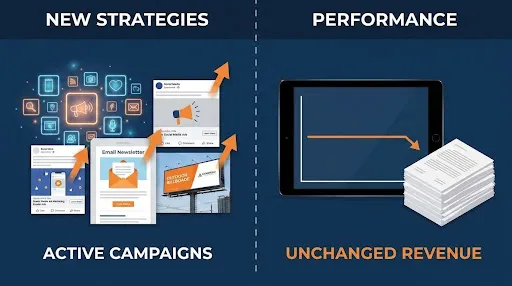
Marketing activity has never been easier to generate. Brands publish content daily, run paid campaigns across multiple platforms, track engagement in real time, and present detailed dashboards that show impressions, clicks, and reach steadily increasing. On the surface, everything appears to be working.
Yet for many organisations, revenue tells a very different story. Despite consistent effort, rising visibility, and growing engagement metrics, actual business growth remains slow or stagnant. This disconnect creates frustration at leadership level and confusion within marketing teams. The question becomes difficult to ignore: if marketing is working, why is revenue not moving?
The answer lies in a fundamental misunderstanding of what marketing activity actually represents. Visibility and engagement are important, but they are not the same as growth. When marketing is not directly connected to acquisition, conversion, and customer value, it can create the illusion of progress while the business itself remains unchanged.
This article explores why marketing can look active without delivering results, where the breakdown typically occurs, and how brands can realign their efforts to drive measurable revenue growth.
The Illusion of Activity in Modern Marketing
Nowadays, it is easy to mistake motion for progress. Content calendars are full, campaigns are running, social media engagement is visible, and analytics dashboards are constantly updating. These signals create a sense that the brand is moving forward.
However, most of these metrics reflect attention rather than commercial impact. Impressions show how many people have seen a message. Clicks indicate interest at a surface level. Engagement suggests interaction, but not necessarily intent. None of these metrics, on their own, confirm that a customer is closer to making a purchase.
This is where the illusion begins. When teams focus heavily on activity metrics, they may optimise for reach and engagement without ensuring that those interactions lead to meaningful business outcomes. As a result, marketing becomes effective at generating visibility but ineffective at driving revenue.
Why Revenue Does Not Follow Activity
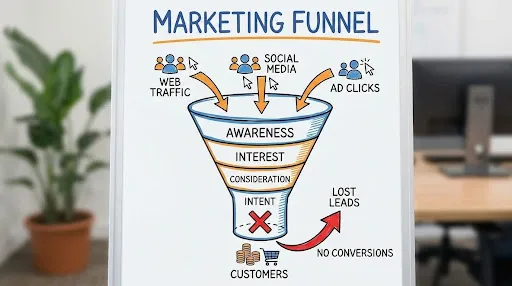
The gap between activity and revenue usually appears when marketing is not designed with a clear pathway to conversion. Campaigns may succeed in attracting attention, but they do not guide the audience toward taking action.
In many cases, content is created to entertain or inform without a defined role in the customer journey. Paid campaigns may drive traffic, but landing pages fail to convert. Leads may be generated, but follow-up processes are inconsistent or poorly timed. Existing customers may be ignored while new audiences are continuously targeted.
Each of these issues represents a break in the system. Individually, they may seem small. Collectively, they create a situation where effort is high but outcomes remain limited.
The core issue is not a lack of marketing activity. It is a lack of alignment between marketing activity and business objectives.
The Three Stages Where Growth Breaks Down
To understand why revenue remains flat, it is useful to look at how marketing connects to the customer journey. There are three critical stages where value is either created or lost: acquisition, activation, and retention.
Customer Acquisition: Attracting the Right Audience
Acquisition is the stage where potential customers first encounter the brand and recognise that it may solve a problem they have. Effective acquisition is not about reaching as many people as possible. It is about reaching the right people with the right message.
When acquisition is misaligned, marketing may generate large volumes of traffic or impressions without attracting qualified prospects. This often happens when targeting is too broad or messaging is too generic. The result is high visibility but low relevance.
If content and campaigns are not designed to attract people who are genuinely interested in the solution, the rest of the funnel becomes difficult to sustain. The business invests in attention that does not convert.
Customer Activation: Turning Interest into Action
Activation is where interest becomes intent. This is the stage where potential customers decide whether to engage further, make an enquiry, or complete a purchase. It is also where many marketing systems begin to fail.
Activation requires clarity, trust, and relevance. Prospects need to understand what the brand offers, why it matters, and what they should do next. If messaging is inconsistent, if value is not clearly communicated, or if the path to action is unclear, momentum is lost.
Many brands generate leads but struggle to convert them because their activation process is weak. Follow-up communication may be generic. Content may not address key objections. Timing may be poorly managed. As a result, interest fades before it becomes revenue.
Customer Retention: Sustaining and Expanding Value
Retention is often overlooked in marketing strategy, yet it is where long-term revenue is built. Acquiring new customers is expensive. Retaining and growing existing customers is more efficient and more profitable over time.
When brands focus only on acquisition, they create a system that constantly needs new inputs to maintain performance. Costs increase, and growth becomes fragile. Without retention strategies such as ongoing engagement, value reinforcement, and customer experience optimisation, the business misses opportunities to deepen relationships and increase lifetime value.
This is one of the most common reasons revenue remains flat despite high activity. The business is continuously starting from zero instead of building on existing momentum.
The Internal Misalignment That Slows Growth

Beyond the customer journey, there is often an internal alignment issue that contributes to stagnant revenue. Different teams may be optimising for different outcomes without a shared definition of success.
Marketing may focus on lead volume or engagement metrics. Sales may focus on closing deals. Leadership may focus on revenue and profitability. When these perspectives are not aligned, the organisation struggles to connect activity with results.
This misalignment leads to conflicting narratives. Marketing reports may show strong performance, while sales teams express concerns about lead quality. Leadership sees increasing spend but limited financial return. Over time, confidence in marketing begins to erode.
The solution is not to increase activity but to align all teams around shared metrics that reflect business outcomes.
Why More Effort Does Not Solve the Problem
When revenue remains flat, the instinct is often to increase effort. More campaigns are launched. More content is produced. More budget is allocated. While these actions may increase visibility, they rarely solve the underlying issue.
If the system is not designed to convert attention into revenue, additional activity simply amplifies inefficiency. The business spends more without improving results.
This is why growth requires a shift from activity-driven marketing to outcome-driven marketing. Instead of asking how much content is being produced or how many campaigns are running, the focus must shift to what those efforts are achieving in terms of customer acquisition, conversion, and value.
How to Realign Marketing with Revenue
To close the gap between activity and results, brands need to rethink how marketing is structured and evaluated.
The first step is to define clear business objectives. Every campaign, piece of content, and channel should have a specific role in supporting these objectives. This creates a direct link between marketing activity and business outcomes.
The second step is to map the customer journey in detail. Understanding how customers move from awareness to purchase allows teams to identify where momentum is lost and where improvements are needed.
The third step is to assign a clear purpose to every piece of content. Content should not exist simply to fill a calendar. It should either attract the right audience, help them understand the value of the offering, or guide them toward taking action.
The fourth step is to improve measurement. Instead of focusing only on surface-level metrics, brands should track indicators that reflect real progress, such as lead quality, conversion rates, customer acquisition cost, and lifetime value.
Finally, organisations must ensure alignment across teams. Marketing, sales, and leadership should operate with a shared understanding of what success looks like and how it will be measured.
What Leaders Should Expect from Marketing
Leadership teams should expect more than visible activity. They should expect clarity on how marketing contributes to revenue, confidence in the data being reported, and a clear explanation of what is working and why.
They should also expect marketing teams to move beyond reporting metrics to providing actionable insights. It is not enough to show performance. Teams must explain how that performance connects to business outcomes and what actions will be taken to improve results.
When marketing operates at this level, it becomes a strategic driver of growth rather than a function that is judged primarily by activity.
Conclusion
Marketing that looks active but fails to drive revenue is not uncommon. It is the result of systems that prioritise visibility over value, activity over outcomes, and effort over alignment. While the surface indicators may appear positive, the underlying structure is not designed to convert attention into business growth.
Real progress begins when marketing is treated as a system that connects acquisition, activation, and retention in a cohesive way. When every element is aligned with clear objectives and measurable outcomes, activity becomes meaningful and results begin to follow.
At Intense Digital, we help brands move beyond surface-level performance and build marketing systems that deliver real, measurable growth. Our approach connects strategy, execution, and data so that every campaign contributes directly to revenue and long-term business value.
If your marketing looks active but revenue remains unchanged, it is time to rethink the system behind the activity. Reach out to Intense Digital for a free consultation and let us help you turn marketing effort into measurable business results.