
Why Your Conversion Rate Is Falling: 6 Areas to Check

When conversion rates begin to fall, the instinct is often to increase advertising spend, change campaign creatives or attract more traffic. These actions may seem reasonable, but they can make the problem more expensive if the real issue lies elsewhere in the customer journey.
A decline in conversion rate is a signal that something may have changed between attracting a potential customer and persuading them to take action. It could be the quality of your traffic, the relevance of your offer, the experience on your landing page, the checkout process or even the way conversions are being tracked. Without understanding where the problem begins, it is difficult to know which intervention will improve performance.
For businesses investing in digital marketing, this distinction matters. More traffic does not necessarily translate into more customers, and higher advertising spend cannot compensate indefinitely for a journey that fails to convert.
At Intense Digital, effective conversion rate optimisation begins with understanding what the data reveals about customer behaviour. Before rebuilding your website or increasing your marketing budget, here are six areas to investigate when your conversion rate starts falling.
1. Check Whether Your Traffic Quality Has Changed
A falling conversion rate does not always mean your website has become less effective. Sometimes, the problem begins before visitors arrive.
If your marketing campaigns are attracting people who are less likely to buy, your conversion rate may decline even when your website experience remains unchanged. This can happen when advertising platforms expand audience targeting, keywords attract less relevant search traffic, campaign messaging promises something the offer does not deliver, or a larger proportion of visitors arrive with low purchase intent.
Consider a business whose website previously attracted visitors searching for a specific service. If its campaigns begin reaching a broader audience interested in general information rather than making a purchase, traffic may increase while conversions fall. Looking only at total visits could make the campaign appear successful, even as its commercial value declines.
The first step is to segment your traffic by source, campaign, audience, device and landing page. Compare conversion rates across these segments to determine whether the decline is widespread or concentrated in particular areas.
For paid campaigns, review changes in targeting, search terms, placements, bidding strategies and creative messaging. For organic search, examine whether the mix of search queries and landing pages has changed. A rise in informational traffic, for example, may be valuable for awareness but should not necessarily be expected to convert at the same rate as visitors searching for a solution they are ready to purchase.
What to look for: A decline in conversion rate concentrated in one channel, campaign, audience or landing page may indicate a traffic-quality problem rather than a website-wide issue.
2. Examine Your Landing Page Experience
Once you have established that your traffic remains relevant, examine what visitors encounter when they arrive.
Your landing page has a specific job: help visitors understand what you offer, why it matters to them and what they should do next. If the page fails to answer these questions quickly and clearly, potential customers may leave without converting.
One common problem is a disconnect between the campaign message and the landing page. An advert may promise a specific benefit, discount or solution, but if visitors cannot find that promise reflected on the page, they may question whether they have reached the right destination.
Other issues include unclear headlines, weak calls to action, excessive information, distracting navigation, poor visual hierarchy and a lack of credible evidence to support the offer. Even when the product or service is relevant, unnecessary friction can make the decision to proceed more difficult.
Review your highest-traffic landing pages and assess them from the visitor’s perspective. Is the main benefit immediately clear? Does the page address the audience’s most important concern? Is the next step obvious? Are testimonials, case studies, product details or other forms of evidence available where they can help visitors make an informed decision?
Avoid assuming that a visually attractive page is necessarily an effective one. Design should support comprehension, confidence and action, not simply make the page look impressive.
Where possible, use behavioural analytics, session recordings or heatmaps to understand how visitors interact with the page. These tools can help reveal whether people are overlooking key information, abandoning forms or struggling to find the next step. Ensure that any session-recording tools are configured with appropriate privacy protections.
What to look for: High traffic combined with low engagement, weak calls to action or substantial drop-offs before the next step may indicate that your landing page needs attention.
3. Test Your Website’s Speed and Mobile Experience
A customer can be interested in your offer and still abandon the journey because your website is difficult to use.
Slow loading times, broken elements, intrusive pop-ups, difficult navigation and poorly designed mobile experiences can introduce friction at the exact point where visitors are deciding whether to continue.
These issues are particularly important for businesses that rely on mobile traffic, where visitors may be browsing on smaller screens or less reliable connections.
A page that performs well on a desktop computer may not deliver the same experience on a mobile device. Buttons may be difficult to tap, forms may require too much typing, important information may sit too far down the page, or payment options may not function as expected.
Start by testing your key conversion pages on both desktop and mobile devices. Check page-loading performance, navigation, form fields, button functionality and the complete journey from the initial visit to the confirmation page. If your website includes an online checkout, complete a test transaction using the payment methods available to customers.
Review performance data by device category. If desktop conversion rates remain stable while mobile conversions decline, investigate mobile-specific problems before making broader changes to your marketing strategy.
Google’s Core Web Vitals can also help you assess important aspects of page experience, including loading performance, responsiveness and visual stability. These metrics are useful diagnostic indicators, although they should be considered alongside actual conversion behaviour rather than treated as a complete measure of user experience.
What to look for: A disproportionate decline in mobile conversions, increased page errors or abandonment around key interactions may indicate technical or usability problems.
4. Review Your Conversion Funnel for Drop-Offs
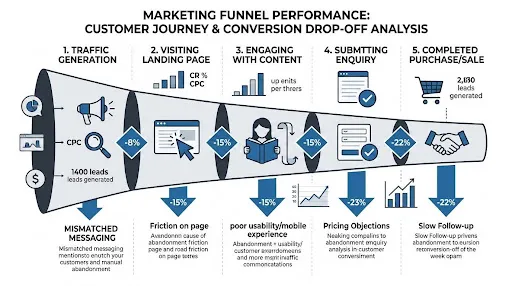
A conversion rarely happens in isolation. Depending on the business, a customer may move from an advert to a landing page, explore a product or service, submit an enquiry, speak with a sales representative and eventually make a purchase.
Every additional step creates an opportunity for friction. If conversion rates are falling, you need to identify where potential customers are leaving the journey.
Looking at the overall conversion rate alone will not always reveal the problem. A funnel analysis provides a more detailed view of how visitors progress through each stage and where the largest losses occur.
For an e-commerce business, this might mean examining product views, add-to-cart actions, checkout initiation and completed purchases. For a B2B company, it could involve tracking landing-page visits, form submissions, qualified leads, booked meetings and opportunities that progress through the sales pipeline.
Suppose a business continues to attract visitors at a stable rate, but fewer people submit enquiry forms. The landing page, offer or form itself may require investigation. If form submissions remain steady but fewer leads become customers, the issue could sit further down the funnel, involving lead quality, sales follow-up, pricing or the sales process.
This distinction is important because the most visible marketing metric may not identify the actual source of the decline. A website can generate leads successfully while the business struggles to convert those leads into revenue.
Map the key steps in your customer journey and measure the proportion of users who progress from one stage to the next. Compare the results over time and segment them by channel, audience and device where relevant. This helps you isolate the stage that needs attention rather than making changes across the entire journey.
What to look for: Identify the funnel stage where the drop-off has increased most significantly, then investigate the specific barriers preventing users from progressing.
5. Reassess Your Offer, Pricing and Trust Signals
Sometimes, the website works as intended, the traffic is relevant and the conversion funnel is functioning correctly, but people still do not take action. In these cases, the problem may be the offer itself or the confidence visitors have in choosing it.
Customer decisions are influenced by perceived value, cost, risk and trust. If your pricing has changed, a competitor has introduced a more compelling alternative, your terms are unclear or customers have become more cautious about purchasing, conversion rates may decline even when the marketing execution remains consistent.
Review whether the offer still meets the needs of the audience you are targeting. Is the value clear enough to justify the price? Are the benefits specific and credible? Are there hidden costs, unclear terms or unexpected steps that could discourage a purchase?
Trust also matters, particularly for businesses asking visitors to make a financial commitment or share personal information. Missing contact details, outdated information, unclear refund policies, weak product descriptions or a lack of credible customer evidence can make potential buyers hesitate.
For service-based businesses, case studies, relevant testimonials, transparent service information and clear explanations of the process can help reduce uncertainty. For e-commerce brands, accurate product details, delivery information, secure payment options and straightforward returns policies can support purchasing confidence.
Avoid responding to every decline with a discount. Price reductions may improve conversions in some situations, but they can also reduce margins without addressing the underlying concern. Before changing the price, establish whether customers are objecting to the cost itself or failing to understand the value they would receive.
What to look for: Increased objections, lower engagement with pricing pages, declining enquiry quality or repeated questions about the offer may point to a value or trust problem.
6. Verify Your Tracking Before Changing Your Strategy
There is one final check that businesses should make before drawing conclusions from a conversion decline: confirm that the data is accurate.
Conversion tracking can break or become inconsistent after website updates, changes to analytics
configurations, adjustments to tag management, consent settings or modifications to form and checkout processes. Advertising platforms and analytics tools may also report different conversion figures because they use different attribution models, reporting windows and counting rules.
If a form submission is no longer recorded correctly, your dashboard may show fewer conversions even when the number of actual enquiries has remained stable. Conversely, duplicate events can inflate reported performance and make a later correction look like a sudden decline.
Start by comparing reported conversions with the underlying business records. Check form submissions in your CRM, completed orders in your e-commerce platform, booked appointments or other records of the action you are measuring. Then test the relevant events and confirm that they fire correctly across the customer journey.
Review whether anything changed around the time the decline began. A website release, analytics update, consent-banner adjustment or change to conversion definitions may help explain the difference.
It is also important to distinguish between a genuine performance decline and a reporting change. If the number of actual customers remains stable but recorded conversions fall, the immediate priority is to fix measurement rather than overhaul the marketing strategy.
Reliable tracking is essential because conversion optimisation depends on comparing performance before and after an intervention. If the measurement is inaccurate, even well-intentioned changes may be based on the wrong assumptions.
What to look for: A sudden drop in recorded conversions without a corresponding change in actual enquiries, orders or customers should trigger a tracking audit before any major marketing decisions are made.
How to Prioritise Your Investigation
When conversion rates fall, it is tempting to investigate every possible cause at once. A more effective approach is to start with the checks that can quickly establish whether the decline is real, where it is
happening and what may be causing it.
Use this sequence to guide your initial investigation:
- Confirm the decline. Compare the conversion rate with an appropriate previous period and check whether traffic volume, conversion volume or tracking definitions have changed. Account for normal fluctuations and seasonal patterns.
- Locate the problem. Segment performance by traffic source, campaign, landing page, device and funnel stage to identify where the decline is concentrated.
- Check for technical issues. Test important pages, forms, checkout processes and conversion events to rule out broken functionality or inaccurate measurement.
- Investigate customer behaviour. Review analytics, user feedback, search terms and behavioural data to identify friction, mismatched expectations or changes in purchase intent.
- Test a focused improvement. Develop a hypothesis, change one meaningful element where practical and measure the outcome against a suitable baseline or control group.
This process helps prevent reactive decisions that increase costs without improving results. It also creates a clearer record of what was changed, why it was changed and whether the intervention made a difference.
Turning Conversion Insights into Growth
A falling conversion rate is not a reason to make changes blindly. It is an opportunity to understand where your marketing and customer journey may be losing value.
The most effective response begins with diagnosis. Determine whether the problem lies in traffic quality, landing-page performance, technical usability, funnel friction, the offer itself or conversion tracking. Then prioritise the issues with the clearest evidence and the greatest potential impact on business outcomes.
It is equally important to measure conversion performance in context. A higher conversion rate is not always better if it comes from attracting fewer qualified customers, reducing prices unnecessarily or optimising for actions that do not contribute to revenue. Businesses should evaluate conversion rate alongside lead quality, customer acquisition cost, revenue, profitability and retention to understand whether improvements are creating real value.
At Intense Digital, we help businesses connect digital strategy, performance marketing, data and conversion rate optimisation to improve the effectiveness of their marketing investments. By identifying
friction across the customer journey and using evidence to guide decisions, businesses can make better use of existing traffic before spending more to acquire it. Your conversion rate tells you what is happening. The customer journey helps you understand why.
If your marketing generates traffic but fails to deliver the results you expect, book a free strategy session with Intense Digital to identify opportunities to improve performance and turn more of your marketing investment into business growth.