

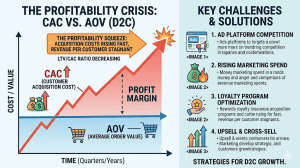
If you’re running a direct-to-consumer brand in 2026, you’ve probably noticed something alarming: your cost to acquire a customer on Meta and Google keeps climbing, but your average order value isn’t keeping pace.
What used to cost ₦3,000 to acquire a customer now costs ₦5,500. Your AOV has crept up from ₦8,000 to ₦9,200 – but not nearly enough to maintain the same margin.
Welcome to the profitability squeeze.
And here’s the hard truth: you can’t ad-spend your way out of this. The solution isn’t a better creative, a new channel, or a bigger budget. The solution is shifting from a campaign mindset to a customer lifetime value mindset.
The D2C Profitability Crisis: Why This Is Happening
Let’s be clear about why CAC keeps rising:
1. Platform Competition is Intensifying
Every brand, from startups to giants, is competing for the same attention on Meta, Google, and TikTok. More advertisers mean higher CPMs. iOS privacy changes (ATT) have made targeting less precise, meaning you’re paying more to reach the right people.
2. Ad Fatigue is Real
Your audience is seeing more ads than ever. The scroll-stopping creative that worked last quarter is tired this quarter. You’re in a constant creative refresh cycle just to maintain performance.
3. Discounting Has Trained Customers to Wait
Many D2C brands have leaned heavily on promos and discount codes to drive volume. The unintended consequence? Customers now wait for sales. They don’t buy at full price anymore, which suppresses your AOV and margin.
4. You’re Over-Reliant on First Purchase
Most D2C brands treat every sale like it has to be profitable on day one. But if your CAC is ₦5,500 and your AOV is ₦9,200, and your COGS is 40%, your first-order profit is razor-thin (or negative once you account for shipping, payment fees, returns, and overhead).
You’re on a treadmill: acquire, fulfill, repeat. There’s no leverage.
The Shift: From Campaigns to Customer Lifetime Value
The brands that are winning right now aren’t the ones spending the most on acquisition. They’re the ones that have built a lifecycle engine – a system that turns one-time buyers into repeat customers, and repeat customers into advocates.
[Inline Image: Comparison of campaign-based model vs LTV-based model – Suggested filename: campaign-model-vs-ltv-model-d2c.jpg]Campaign model:
- Goal: Drive transactions this month
- Focus: New customer acquisition
- Measure: ROAS, CAC, conversion rate on first purchase
- Result: Revenue is lumpy, dependent on ad spend, unprofitable at scale
LTV model:
- Goal: Maximize revenue per customer over 12-24 months
- Focus: Acquisition + activation + repeat + referral
- Measure: LTV, LTV:CAC ratio, repeat purchase rate, retention cohorts
- Result: Compounding revenue, lower reliance on paid ads, profitable at scale
Here’s the unlock: if you can get a customer to buy twice, your effective CAC drops by nearly half. If they buy three times and refer a friend, you’ve turned an unprofitable first sale into a highly profitable customer relationship.
What a Smarter Replenishment Journey Looks Like
Let’s take a common D2C example: a beauty or skincare brand selling a product with a 60-day usage cycle (say, a serum or face cream).
Typical approach (broken):
- Customer buys once
- Gets added to a generic newsletter
- Receives random promo emails
- Eventually forgets about the brand
- Sees a competitor ad and switches
Repeat purchase rate: 15-20%
Lifecycle approach (optimized):
- Customer buys once
- Day 1: Welcome email with usage tips and brand story
- Day 3: Tutorial or UGC video showcasing results
- Day 45: “You’re probably halfway through – here’s what to expect next”
- Day 55: “Running low? Reorder now and save 10%” (replenishment nudge)
- Day 65 (if no purchase): “Don’t run out – here’s a reminder + testimonial”
- Day 75 (if still no purchase): Winback offer or alternative product suggestion
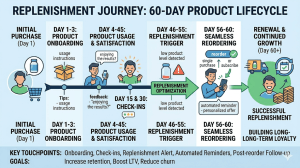
Repeat purchase rate with this system: 35-45%
That difference – going from 20% to 40% repeat rate – doesn’t just improve revenue. It fundamentally changes your unit economics. Suddenly, you can afford to pay more to acquire a customer, because you know the payback will come from purchase two and three, not just purchase one.
Five Lifecycle Experiments Every D2C Brand Should Run
You don’t need a massive lifecycle platform or a team of ten to start. You can run these experiments with basic email/SMS tools, a bit of segmentation, and some discipline.
Experiment 1: Welcome Series Testing
Most D2C brands send one welcome email. Test a 3-email welcome series:
- Email 1: Thank you + brand story + social proof
- Email 2: How to use the product / get the most value
- Email 3: Introduce the broader range or loyalty program
Measure: Repeat purchase rate in first 60 days, engagement rate, unsubscribe rate
Experiment 2: Replenishment Reminder (Behavior-Triggered)
For consumable products, set up a replenishment reminder based on expected usage cycle, not arbitrary timing.
Measure: Repeat purchase rate, time between purchases
Experiment 3: Winback Campaigns for Lapsed Customers
Identify customers who haven’t purchased in 90+ days. Send a targeted winback campaign:
- “We miss you” message
- Highlight new products or improvements
- Special offer or incentive
Measure: Reactivation rate, incremental revenue
Experiment 4: Post-Purchase Cross-Sell
Instead of trying to upsell on the checkout page (which can hurt conversion), send a post-purchase email 7-10 days after delivery:
- “How’s [product] working for you?”
- “Customers who bought X also love Y”
- Discount or bundle offer
Measure: Attach rate, AOV on second purchase
Experiment 5: Referral Prompts at High-Satisfaction Moments
After a positive interaction (e.g., 5-star review, customer service resolution, repeat purchase), ask for a referral:
- “Love it? Share it with a friend and you both save ₦500”
- Simple referral link tracked via UTM or referral code
Measure: Referral rate, CAC of referred customers
Run these experiments one at a time, measure the impact, roll out the winners, and move to the next. Small, consistent lifts compound.
You Don’t Need More Channels – You Need a Smarter System
One of the most common mistakes we see at Intense Digital: D2C brands that are stretched thin across six or seven channels, doing all of them poorly.
They’re running Meta ads, Google, TikTok, influencer partnerships, SEO, email, SMS – and none of it is integrated. Every channel is a silo. There’s no unified customer view, no consistent journey, and no way to measure what’s actually driving LTV.
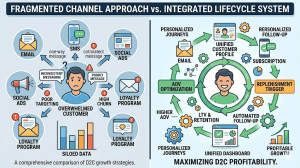
Better approach:
- Pick 2-3 core acquisition channels and do them well (e.g., Meta + Google, or Meta + TikTok)
- Build a strong lifecycle engine (email, SMS, WhatsApp) that works across all acquisition sources
- Measure everything in one place: LTV by cohort, repeat purchase rate, CAC payback, contribution margin
You’ll likely find that one channel drives higher LTV customers than another. That insight lets you shift budget intelligently, not based on first-purchase ROAS, but on long-term profitability.
The Metrics That Actually Matter (And How to Track Them)
If you’re only tracking ROAS and CAC, you’re missing the full picture. Here are the metrics you should be reviewing monthly:
| Metric | What It Tells You | Target / Benchmark |
| CAC | Cost to acquire a customer | Depends on LTV, but typically <30% of LTV |
| AOV | Average order value | Track by channel and over time |
| Repeat Purchase Rate | % of customers who buy again | 25-40% within 90 days is healthy for consumables |
| Time to Second Purchase | How long between purchase 1 and 2 | Shorter is better – indicates engagement |
| Customer Retention Rate | % of customers still buying after 6/12 months | Track by cohort |
| LTV (12-month) | Revenue from a customer in first 12 months | Should be 3-5x CAC for healthy growth |
| LTV:CAC Ratio | LTV ÷ CAC | 3:1 or better is solid; 5:1+ is excellent |
| Payback Period | Months to recover CAC | <6 months ideal for most D2C |
| Contribution Margin per Customer | Revenue – COGS – CAC – shipping/fees | Must be positive to scale profitably |
Most D2C brands can pull these numbers from Shopify + their ad platforms + a bit of spreadsheet work. If you want to get more sophisticated, tools like Lifetimely, Peel, or Segment can automate cohort analysis.
Action: Build this scorecard this month. Review it monthly with your team. Make decisions based on LTV and payback, not just ROAS.
How We Help D2C Brands Build Profitable Growth Engines
At Intense Digital, we work with digital-first consumer brands to shift from campaign dependency to lifecycle-driven growth.
Here’s what that looks like in practice:
Phase 1: Audit and Diagnose (Weeks 1-4)
- Map your current customer journey from ad click to repeat purchase
- Audit tracking and data (Are you measuring LTV correctly? Do you have clean cohort data?)
- Identify your highest-LTV customer segments and acquisition sources
- Benchmark your metrics against category norms
Phase 2: Build the Lifecycle Engine (Weeks 5-8)
- Set up or optimize welcome series, replenishment reminders, winback campaigns
- Implement post-purchase flows (review requests, cross-sell, referrals)
- Fix segmentation so messaging is relevant (new vs repeat, high-value vs low, product category, etc.)
- A/B test messaging, timing, and offers
Phase 3: Optimize Acquisition for LTV (Weeks 9-12)
- Shift acquisition strategy to prioritize channels and audiences with highest LTV, not just lowest CAC
- Test creatives and offers that attract repeat buyers, not just bargain hunters
- Scale spend where payback is fastest and LTV is highest
- Integrate acquisition and lifecycle so they work as one system
Each sprint is built around a prioritized backlog of experiments – we’re not doing everything at once, we’re making small, measurable bets that compound.
Real Example: How 5 Small Experiments Added Up to 28% Revenue Lift
We worked with a D2C beauty brand in Lagos that was spending heavily on Meta and seeing diminishing returns. CAC had doubled in 12 months. Repeat purchase rate was under 18%.
Over 90 days, we ran five experiments:
- Welcome series (3 emails instead of 1) → 12% increase in 60-day repeat rate
- Replenishment reminder at Day 50 for their hero product → 9% increase in repeat purchase
- Winback campaign for 90+ day lapsed customers → reactivated 6% of lapsed base
- Post-purchase cross-sell email at Day 10 → 8% of recipients bought a second product
- Referral prompt after second purchase → 4% of repeat customers referred a friend
None of these were huge wins on their own. But together:
- Repeat purchase rate went from 18% to 31%
- LTV (12-month) increased by 42%
- Effective CAC dropped by 24% (because more revenue per customer)
- Overall revenue grew 28% with the same acquisition budget
That’s the power of lifecycle thinking. You’re not hunting for one big idea – you’re compounding small, consistent improvements.
From Campaign Calendar to Growth System
Most D2C brands are still operating off a campaign calendar:
- January: New Year sale
- February: Valentine’s promo
- March: Spring collection launch
- April: Easter sale
… and so on.
There’s nothing wrong with campaigns – but if that’s all you’re doing, you’re leaving massive revenue on the table.
Growth systems run in the background, independent of your campaign calendar:
- New customers enter welcome flows
- Customers nearing end of product cycle get replenishment reminders
- Lapsed customers get winback messages
- Happy customers get referral prompts
These systems work 24/7, generating revenue without you having to “launch” anything.
Ready to Build Your Lifecycle Engine?
If your CAC is rising, your ROAS is shrinking, and you’re feeling the profitability squeeze, it’s time to make the shift from campaigns to customer lifetime value.
You don’t need to rebuild everything overnight. Start with one lifecycle flow. Measure it. Improve it. Add the next one.
At Intense Digital, we help D2C brands design, implement, and optimize lifecycle engines that turn one-time buyers into repeat customers and repeat customers into advocates. We measure success in LTV, repeat rate, and profitability – not just first-purchase ROAS.
Let’s build your lifecycle engine together.
Book a complimentary 30-minute growth audit. We’ll review your current customer journey, identify the highest-impact opportunities, and show you what a 90-day lifecycle sprint could look like for your brand.